Service quality
Make service faster and more consistent without turning the customer experience into a chatbot maze.
Shorter queues, better first responses, cleaner escalation paths, and a service team that protects trust while moving faster.
Fast
First response
Give agents prepared context and response drafts instead of starting from scratch.
Consistent
Resolution quality
Use quality checks and routing rules to reduce variation across the team.
Visible
Backlog risk
Help leaders see queues, escalations, repeat issues, and service failure patterns.
Field Pattern
Service automation works when autonomy is explicit.
Observed Pattern
The field model uses a practical autonomy ladder: some work can be fully automatic, some should be AI-drafted, and some must stay human-led. That same model is the right foundation for service operations because speed only helps if customers still feel judgment, context, and ownership.
Operating Rules
Auto: classify, summarize, enrich, and route routine requests.
AI Draft: prepare responses, knowledge suggestions, and escalation packets for human review.
Human Led: own sensitive customers, ambiguous exceptions, negotiation, and relationship moments.
Anonymized Operator View
What the service desk shows when speed has controls.
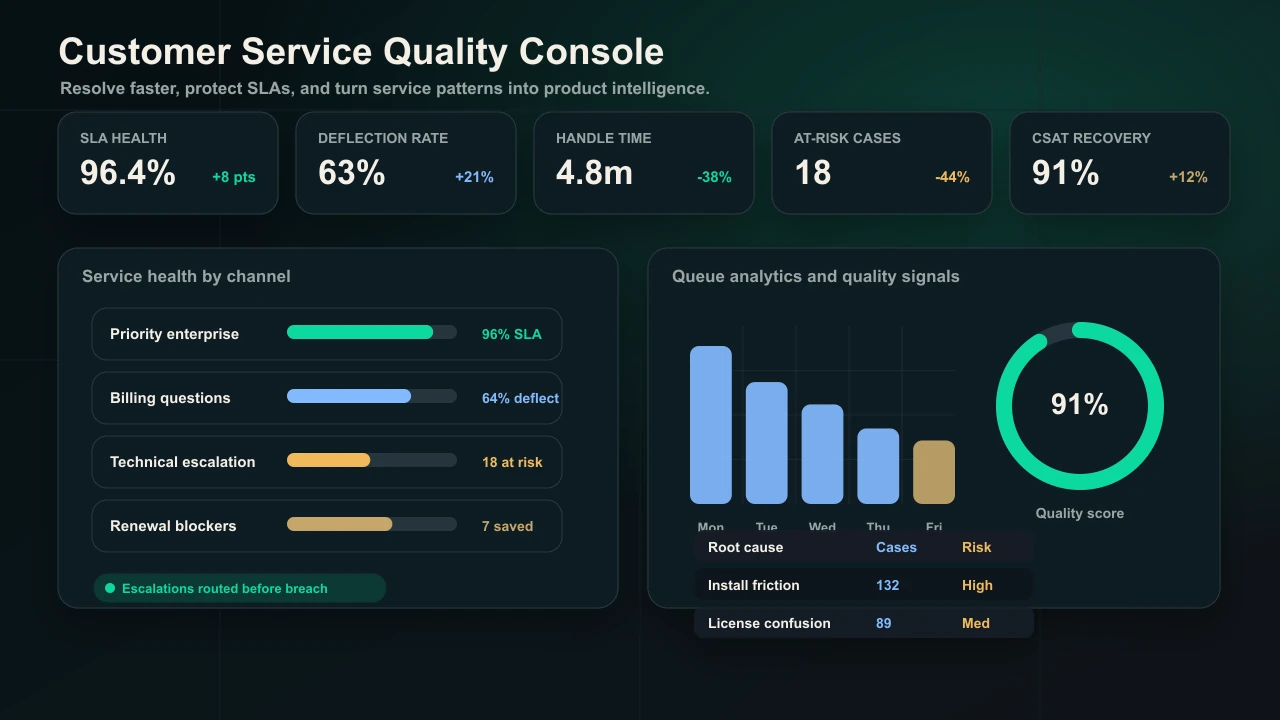
The right service view gives leaders a live picture of demand, escalation risk, draft quality, customer sentiment, and where human judgment is required before trust is damaged.
Auto
Classify, summarize, route, dedupe, and enrich routine service requests.
AI Draft
Prepare replies, customer histories, escalation packets, and knowledge updates.
Human Led
Own sensitive customers, exceptions, concessions, and relationship recovery.
Service Quality Command
Daily backlog and escalation standup
16m
Priority triage
High-risk requests move to the right owner first.
92%
Draft QA pass
Responses meet tone, policy, and context checks before send.
24
At-risk accounts
Customer issues are grouped by renewal, SLA, and sentiment risk.
Pipeline Control
Enterprise renewal complaint cluster
Service leader
Negative sentiment + open SLA miss
Send recovery packet for human approval.
Multi-site onboarding delay
Implementation lead
Three handoff misses in seven days
Confirm owner and next customer update.
Repeat billing exception
Support ops
Recurring ticket theme detected
Route root-cause packet to finance ops.
Action Plan
Day 1
Classify demand and separate auto, draft, and human-led work.
Day 2
Draft customer responses and escalation packets with QA gates.
Day 3
Review sentiment, backlog risk, and priority accounts.
Weekly
Convert repeated issues into knowledge and prevention work.
Intelligence Gaps
Account history is split across CRM, helpdesk, and notes.
Escalation owner is unclear for SLA-adjacent requests.
Knowledge article needs update after repeated ticket pattern.
Feedback Loop
Customer signal
Ticket, email, sentiment, SLA, or account-risk event.
Workflow desk
Classify, draft, route, quality-check, and flag risk.
Team judgment
Approve, personalize, resolve, and improve the knowledge base.
Best Fit
Where this is worth the effort.
Good Candidate
Companies with growing service volume, uneven response quality, manual ticket routing, or too much tribal knowledge trapped in senior staff.
Diagnostic Checklist
Customers wait because every request is treated like a blank page.
Escalations depend on who is working, not on a consistent operating model.
Quality varies across agents, locations, products, or customer segments.
Managers lack a clear view of backlog risk, customer sentiment, and preventable rework.
Operating Build
What ClearForge puts around the work.
01
Autonomy layer
Separate work into auto, AI-drafted, and human-led paths so the team knows exactly where judgment belongs.
02
Resolution layer
Draft responses, summarize account history, recommend fixes, and surface relevant knowledge.
03
Escalation layer
Route sensitive, high-value, or ambiguous cases to the right human with context already prepared.
04
Quality layer
Monitor response quality, tone, policy adherence, repeat issues, and coaching opportunities.
First Builds Worth Shipping
Ticket triage and routing
Classifies inbound requests and routes them based on urgency, customer tier, topic, and required expertise.
Autonomy badge rules
Marks each workflow as auto, AI draft, or human led so leaders can expand automation without losing control.
Agent assist workspace
Summarizes history, drafts responses, suggests fixes, and flags risks before a human sends anything.
Service quality review
Scores resolution quality, sentiment, policy adherence, and preventable rework for manager review.
Knowledge gap loop
Identifies repeated questions and missing documentation so the service desk improves every week.
Implementation Path
From use case to management habit.
01 · Week 1
Map service demand
Review support volume, categories, escalation paths, quality standards, knowledge sources, and risk rules.
02 · Weeks 2-3
Build triage and assist
Ship autonomy rules, ticket classification, history summaries, response drafting, and routing workflows.
03 · Weeks 4-6
Install quality controls
Add review queues, escalation rules, coaching dashboards, and customer-risk alerts.
04 · Ongoing
Improve the service loop
Use real cases to improve knowledge, prompts, routing, and service leadership cadence.
Related Paths
Keep exploring.
FAQ
Questions buyers ask first.
Does this replace service reps?
The stronger pattern is augmentation: AI handles triage, summaries, drafts, checks, and routing while humans own judgment, relationship moments, and exceptions.
How do you prevent bad AI replies?
We design approval gates, restricted knowledge sources, escalation rules, audit logs, and quality reviews before customer-facing automation expands.
Can this work with our existing helpdesk?
Yes. The usual approach is to integrate with the current ticketing and knowledge tools rather than force a platform replacement first.
Find where this belongs in your company.
The fastest path is choosing one workflow worth fixing, building the controls around it, and training your team into the new cadence.