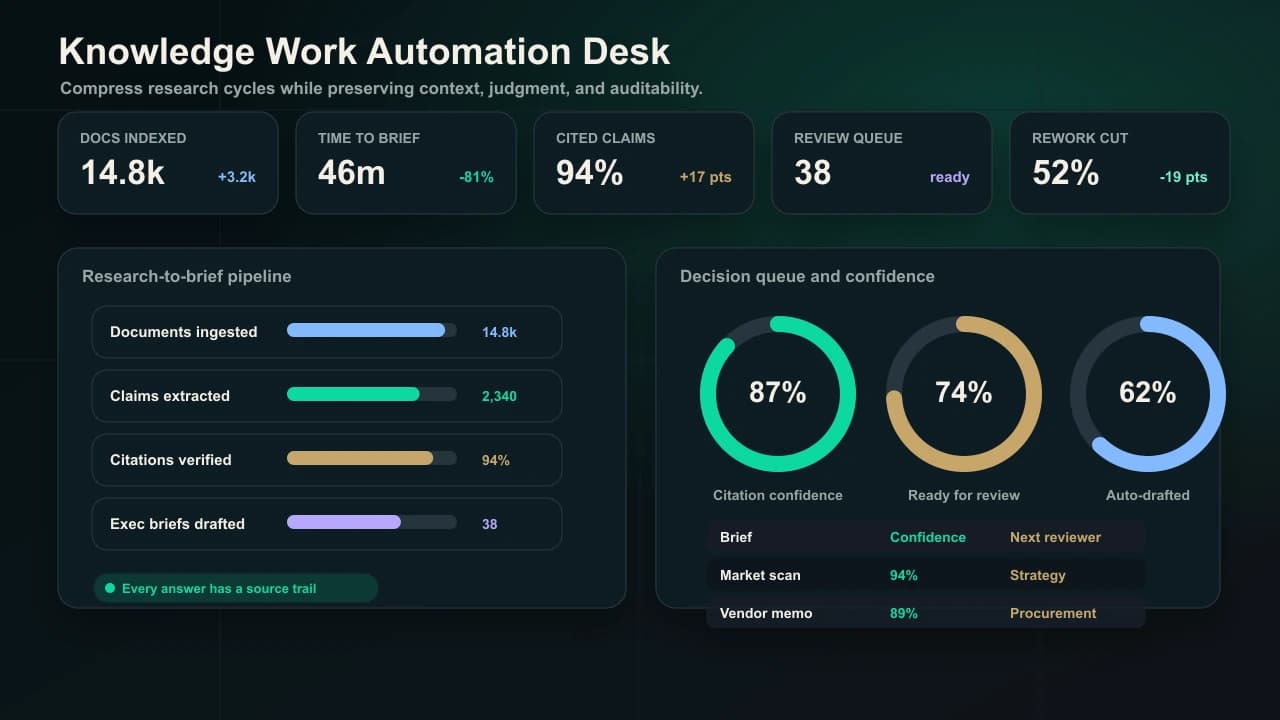
Speed to insight
Stop making your best people hunt for context. Put the evidence, draft, and review path around them.
Faster research, cleaner reporting, more consistent analysis, and better use of scarce expert judgment.
Speed
To first draft
Move from blank page to review-ready analysis faster.
Trace
Evidence trail
Keep citations, sources, and decision context attached to the work.
Reuse
Institutional memory
Turn repeated analysis into reusable knowledge assets.
Field Pattern
The reporting agent should produce decisions, not just documents.
Observed Pattern
The strongest industrial intelligence outputs combined sourced research, opportunity scoring, intelligence gaps, a 30-day action plan, playbooks, and source bibliographies. That is the better pattern for knowledge work: AI prepares a decision packet with evidence, gaps, and next actions attached.
Operating Rules
Require source trails and confidence notes so leaders can inspect the reasoning.
Separate facts, gaps, recommendations, and human decisions into distinct sections.
Turn each finished report into reusable memory for the next market, customer, or workflow.
Anonymized Operator View
What a decision packet looks like before it reaches an executive.
The strongest reports combine source trails, opportunity tables, evidence gaps, recommendations, and owners. That makes the work useful to an executive who needs to decide, fund, or direct action.
Auto
Collect sources, extract entities, maintain trails, and refresh research queues.
AI Draft
Prepare summaries, comparisons, briefs, recommendations, and gap lists.
Human Led
Judge confidence, make strategic decisions, and approve external use.
Decision Intelligence Workspace
Monthly market and decision review
82p
Market study
Deep research turned into executive-ready decisions.
358
Companies mapped
Targets grouped by segment, fit, and strategic relevance.
5
Priority moves
Recommendations tied to action owners and evidence gaps.
Pipeline Control
Industrial market-entry thesis
Strategy lead
Segment growth + competitor whitespace
Review investment thesis and source confidence.
Customer ecosystem map
Growth ops
Top account network expanded
Validate relationships and near-term buying events.
Competitive capability scan
Executive sponsor
New entrant signal in target segment
Close pricing and channel evidence gaps.
Action Plan
Step 1
Gather approved sources and extract structured evidence.
Step 2
Score targets, identify gaps, and separate facts from inference.
Step 3
Draft the decision packet with recommendations and owners.
Step 4
Capture executive decisions back into reusable memory.
Intelligence Gaps
Procurement timing is inferred and needs source confirmation.
Competitor share estimate requires a higher-confidence citation set.
Internal account owner feedback has not been added to the memo.
Feedback Loop
Knowledge signal
Source, document, meeting note, report, or market event.
Workflow desk
Extract, compare, cite, score, draft, and highlight uncertainty.
Team judgment
Decide, annotate, approve, and teach the next research loop.
Best Fit
Where this is worth the effort.
Good Candidate
Teams buried in reports, documents, research, approvals, client prep, compliance reviews, or knowledge trapped across tools.
Diagnostic Checklist
Experts spend valuable hours gathering context before they can make a decision.
Reports are manually assembled from tools, documents, meetings, and spreadsheets.
Teams duplicate research because prior work is hard to find or trust.
Quality depends on who prepared the memo, not on a repeatable review standard.
Operating Build
What ClearForge puts around the work.
01
Source layer
Connect trusted documents, business tools, policies, prior work, meeting notes, and approved external sources.
02
Evidence layer
Summarize, compare, extract, classify, and keep source trails attached to the next human decision.
03
Decision layer
Prepare recommendations, open questions, risks, and evidence trails for review.
04
Memory layer
Capture decisions and reusable knowledge so the next report starts smarter instead of resetting every week.
First Builds Worth Shipping
Research and synthesis agent
Collects approved context, summarizes findings, compares options, and highlights evidence gaps.
Document intake and extraction
Reads PDFs, contracts, forms, reports, and emails to pull structured fields and review flags.
Decision packet workflow
Assembles executive summary, evidence, gaps, recommendations, action plan, and follow-up owners.
Expert handoff packet
Prepares the context, evidence, and recommended next step before a specialist spends time.
Implementation Path
From use case to management habit.
01 · Week 1
Choose the knowledge loop
Find the recurring decision, report, review, or research workflow with high expert time cost.
02 · Weeks 2-3
Connect trusted context
Define source rules, document handling, extraction fields, and review standards.
03 · Weeks 4-6
Ship decision support
Deploy synthesis, draft, review, action-plan, and approval workflows with evidence trails and human checks.
04 · Ongoing
Build memory
Capture reusable answers, improve source quality, and expand to adjacent knowledge workflows.
Related Paths
Keep exploring.
FAQ
Questions buyers ask first.
How do you prevent hallucinations in knowledge work?
We constrain sources, require evidence trails, add review checkpoints, and design outputs around decision support rather than unsupervised final authority.
Can this use internal documents securely?
Yes, but the architecture depends on access controls, data sensitivity, retention requirements, and where the knowledge lives.
What is a good first workflow?
Good first workflows repeat often, consume expert time, have clear source material, and produce a consistent output such as a report, brief, review, or recommendation.
Find where this belongs in your company.
The fastest path is choosing one workflow worth fixing, building the controls around it, and training your team into the new cadence.