Quality and risk
Catch the misses before they become margin leakage, rework, or customer pain.
Earlier detection, faster triage, clearer ownership, better root-cause visibility, and fewer repeated quality failures.
Earlier
Detection
Move exception discovery closer to the source of the problem.
Faster
Triage
Reduce ambiguity about owner, severity, and next action.
Lower
Repeat failure
Use pattern visibility to remove causes, not just close tickets.
Field Pattern
The best quality use cases begin with event triggers.
Observed Pattern
In the industrial GTM work, quality-control crises and recall remediation became high-intent buying signals because they were urgent, funded, and tied to executive risk. Inside an operating company, the same logic applies: detect the quality event early, classify severity, assign ownership, and learn from the repeat pattern.
Operating Rules
Monitor recalls, complaints, inspection failures, returns, warranty claims, and operational disruptions.
Route exceptions by severity, customer impact, regulatory risk, and likely root cause.
Use repeat-pattern mining to turn closed issues into prevention work.
Anonymized Operator View
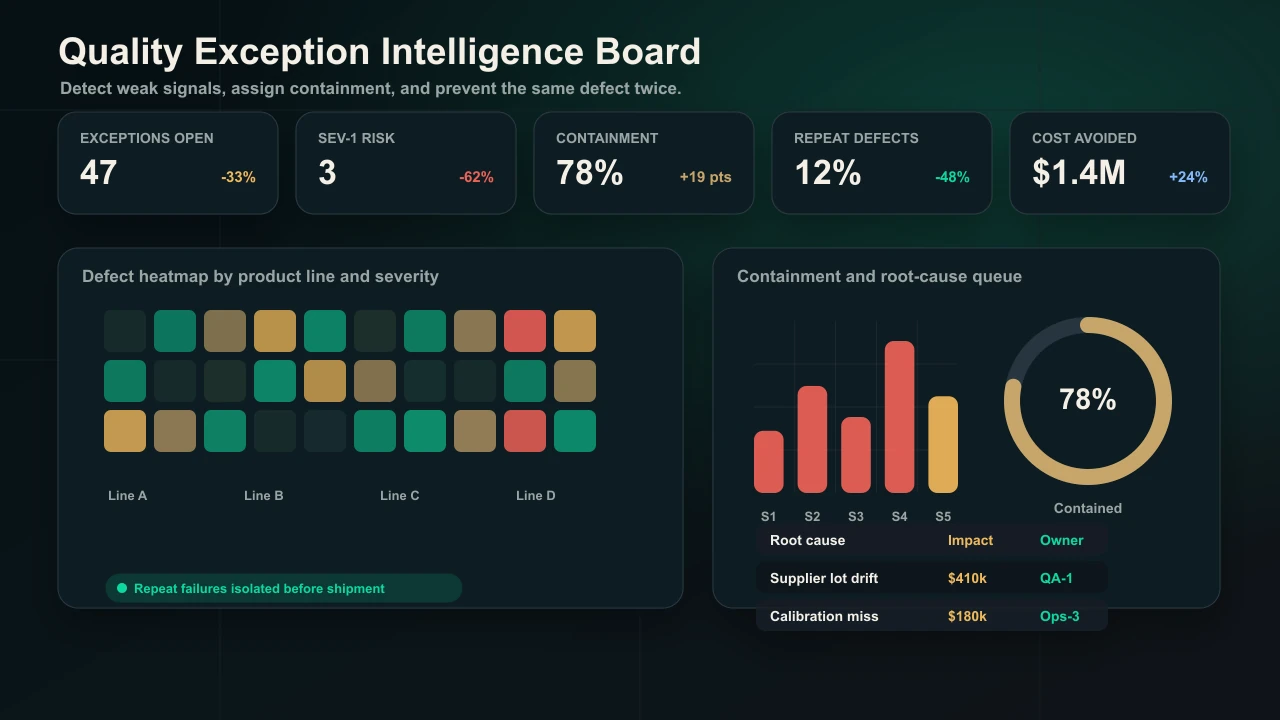
What the exception view shows before quality slips compound.
A serious quality workflow shows severity, ownership, customer exposure, root-cause evidence, corrective action, and repeat patterns before failures turn into rework, claims, or reputation damage.
Auto
Detect signals, classify severity, group patterns, and alert owners.
AI Draft
Prepare evidence summaries, root-cause hypotheses, and action packets.
Human Led
Approve severity, containment, customer communication, and corrective action.
Exception Control Tower
Daily severity and corrective-action review
3
Severity tiers
Clear routing for operational, customer, and regulatory risk.
18
Repeat patterns
Closed issues mined for prevention opportunities.
4
Actions due
Corrective work tracked by owner, proof, and deadline.
Pipeline Control
Warranty claim cluster
Quality director
Repeat issue across two customer segments
Confirm exposure and containment owner.
Inspection drift in final review
Plant lead
Tolerance miss above threshold
Draft corrective action and evidence request.
Supplier defect pattern
Supply quality
Three related nonconformance notes
Compare supplier lots and customer impact.
Action Plan
Day 1
Define event triggers, severity rules, and ownership paths.
Day 3
Launch detection, classification, and context packets.
Week 2
Connect corrective actions to evidence and deadline tracking.
Weekly
Review repeat patterns and prevention work with leaders.
Intelligence Gaps
Root-cause evidence is still anecdotal in several closed issues.
Customer exposure is not tied to severity rules early enough.
Corrective-action proof is stored outside the management review.
Feedback Loop
Quality signal
Claim, inspection, return, complaint, recall, or nonconformance.
Workflow desk
Detect, classify, group, route, and summarize evidence.
Team judgment
Contain, correct, verify, and remove the repeat cause.
Best Fit
Where this is worth the effort.
Good Candidate
Manufacturers, service operators, insurers, distributors, and complex workflow teams where exceptions are costly and quality variation compounds.
Diagnostic Checklist
Exceptions are found late, after cost, customer impact, or rework has already grown.
Teams classify and route issues inconsistently.
Root-cause patterns are buried in notes, tickets, inspections, and spreadsheets.
Managers see quality metrics but cannot quickly connect them to specific process failures.
Operating Build
What ClearForge puts around the work.
01
Trigger layer
Monitor signals from tickets, recalls, inspections, documents, transactions, sensors, and workflow events.
02
Classification layer
Group exceptions by severity, source, customer risk, likely cause, and required next action.
03
Resolution layer
Route ownership, prepare context, suggest remediation, and escalate high-risk cases.
04
Learning layer
Identify repeated patterns so teams remove causes instead of only resolving symptoms.
First Builds Worth Shipping
Quality event triage
Prioritizes issues by business impact, urgency, severity, customer exposure, and downstream risk.
Quality review assistant
Summarizes evidence, compares against standards, and prepares the next review action.
Root-cause pattern mining
Finds recurring issue types, locations, teams, products, vendors, or process steps.
Corrective action workflow
Tracks owners, due dates, evidence, completion, and management review cadence.
Implementation Path
From use case to management habit.
01 · Week 1
Define quality signals
Map event triggers, exception types, sources, severity rules, ownership, and downstream business impact.
02 · Weeks 2-3
Build detection and routing
Ship classification, prioritization, owner routing, and context packet workflows.
03 · Weeks 4-6
Install corrective action
Add root-cause views, action tracking, escalation rules, and management review routines.
04 · Ongoing
Reduce repeats
Tune signals, improve standards, and expand from one exception class to the next.
Related Paths
Keep exploring.
FAQ
Questions buyers ask first.
Is this computer vision?
Sometimes, but not always. Many high-value quality builds start with tickets, documents, inspections, transactions, or workflow metadata before adding vision.
Can AI make quality decisions by itself?
For high-risk workflows, AI should assist detection, classification, context, and routing while humans own final judgment until reliability is proven.
What makes this different from a dashboard?
Dashboards show what happened. An exception workflow routes the issue, prepares context, tracks action, and helps leaders prevent the repeat.
Find where this belongs in your company.
The fastest path is choosing one workflow worth fixing, building the controls around it, and training your team into the new cadence.