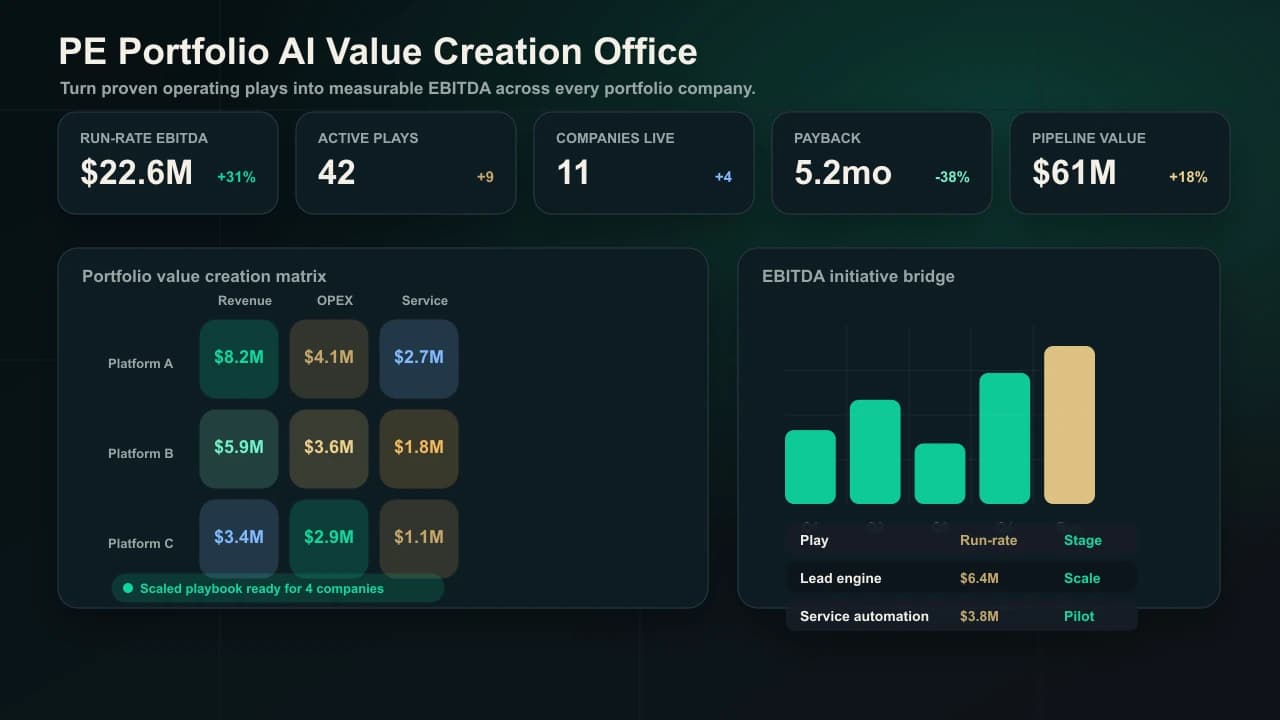
Portfolio growth
Find the AI plays that repeat across the portfolio. Build the first proof, then reuse what works.
Clearer prioritization, faster execution, reusable playbooks, stronger operating cadence, and a better story for value creation.
Rank
By value and readiness
Prioritize the right company and workflow before spending build effort.
Reuse
Across companies
Turn one successful sprint into a portfolio playbook.
Measure
Operating impact
Tie AI adoption to practical KPIs that matter in the hold period.
Field Pattern
Reusable value creation comes from retuning the same operating pattern.
Observed Pattern
The same operating pattern can support different business lines: one trigger taxonomy for industrial projects, another for automation demand, another for data-center infrastructure, another for specialty materials. That is the portfolio lesson: build the architecture once, retune it for each company and value lever.
Operating Rules
Screen companies for repeatable revenue, service, operations, reporting, and quality plays.
Build a first implementation that creates templates, taxonomies, prompts, scorecards, and cadence.
Scale by pattern while preserving each company's local workflow, market, and data reality.
Anonymized Operator View
What a portfolio AI view makes visible.
Operating partners need to see which AI plays are worth funding, where the sponsor and data are ready, how the sprint is performing, and what can be reused across the portfolio.
Auto
Collect portfolio inputs, refresh scorecards, and flag blocked initiatives.
AI Draft
Prepare playbooks, sprint briefs, board updates, and KPI variance notes.
Human Led
Prioritize capital, pick sponsors, resolve constraints, and repeat the pattern.
Portfolio Value Creation Map
Monthly operating partner review
5
Platform plays
Revenue, service, operations, reporting, and quality patterns.
90d
First playbook
One sprint becomes reusable templates and governance.
KPI
Board trace
Adoption, cycle time, quality, revenue, and margin tracked.
Pipeline Control
Revenue intelligence sprint
Operating partner
Shared pipeline visibility gap
Package trigger taxonomy for next company.
Service triage sprint
Portfolio COO
Backlog and renewal-risk pattern
Confirm helpdesk data access and QA rules.
Margin workflow sprint
Value creation lead
Manual approval drag across sites
Set baseline cycle-time and cost metrics.
Action Plan
Weeks 1-2
Screen companies by value, readiness, and repeatability.
Weeks 3-6
Build the highest-return sprint in one company.
Weeks 7-10
Codify templates, governance, integrations, and KPIs.
Ongoing
Scale by pattern and report impact in operating reviews.
Intelligence Gaps
Sponsor ownership differs by company and must be confirmed before build.
KPI baselines are inconsistent across similar workflows.
Data access risk needs to be scored before the next sprint wave.
Feedback Loop
Portfolio signal
Repeated pain, sponsor pull, KPI gap, or exit narrative lever.
Workflow desk
Screen, rank, brief, track, and package reusable playbooks.
Team judgment
Fund, govern, remove blockers, and expand what works.
Best Fit
Where this is worth the effort.
Good Candidate
PE firms, operating partners, and portfolio leadership teams that need practical AI initiatives tied to hold-period economics.
Diagnostic Checklist
Portfolio companies are experimenting with AI but not turning it into adopted workflows.
Operating teams lack a common way to prioritize AI by value, risk, and time-to-impact.
Similar revenue, service, and operations problems repeat across companies without reusable playbooks.
AI progress is hard to translate into board updates, KPI movement, or exit narrative.
Operating Build
What ClearForge puts around the work.
01
Portfolio map
Assess companies by data readiness, workflow maturity, operating pain, and value creation levers.
02
Pattern layer
Define reusable taxonomies, workflows, prompts, scorecards, and operating cadences for revenue, service, operations, reporting, and quality.
03
Sprint layer
Ship the highest-value plays inside selected companies with practical governance and measurement.
04
Board layer
Track adoption, KPI impact, risk, and next actions in a cadence operating partners can manage.
First Builds Worth Shipping
Portfolio pattern screen
Ranks companies and workflows by value, repeatability, implementation complexity, data readiness, and sponsorship.
Revenue and service playbooks
Reusable workflows for pipeline acceleration, service triage, customer risk, and follow-up discipline.
Operations and margin playbooks
AI-assisted workflows for order handling, approvals, reporting, exception management, and rework reduction.
Board-ready value tracking
Translates AI initiatives into adoption, cycle time, quality, revenue, cost, and margin measures.
Implementation Path
From use case to management habit.
01 · Weeks 1-2
Screen the portfolio
Assess AI opportunities by value creation lever, workflow maturity, data readiness, and leadership pull.
02 · Weeks 3-6
Run the first sprint
Build and deploy the highest-return workflow inside one portfolio company with clear targets.
03 · Weeks 7-10
Codify the playbook
Package what worked into templates, governance, integrations, and operating routines.
04 · Ongoing
Scale by pattern
Apply the playbook to similar portfolio companies and track adoption in operating reviews.
Related Paths
Keep exploring.
FAQ
Questions buyers ask first.
How do you prioritize across portfolio companies?
We rank opportunities by business value, workflow maturity, data availability, integration complexity, leadership sponsorship, and how reusable the play may be across the portfolio.
Does each company need a custom AI strategy?
Each company needs local workflow fit, but the best PE approach is pattern-based: build reusable plays and adapt them to the operating context.
How does this support exit prep?
The output is not an AI story alone. It is evidence of better operating cadence, speed, quality, customer responsiveness, margin visibility, and adoption.
Find where this belongs in your company.
The fastest path is choosing one workflow worth fixing, building the controls around it, and training your team into the new cadence.